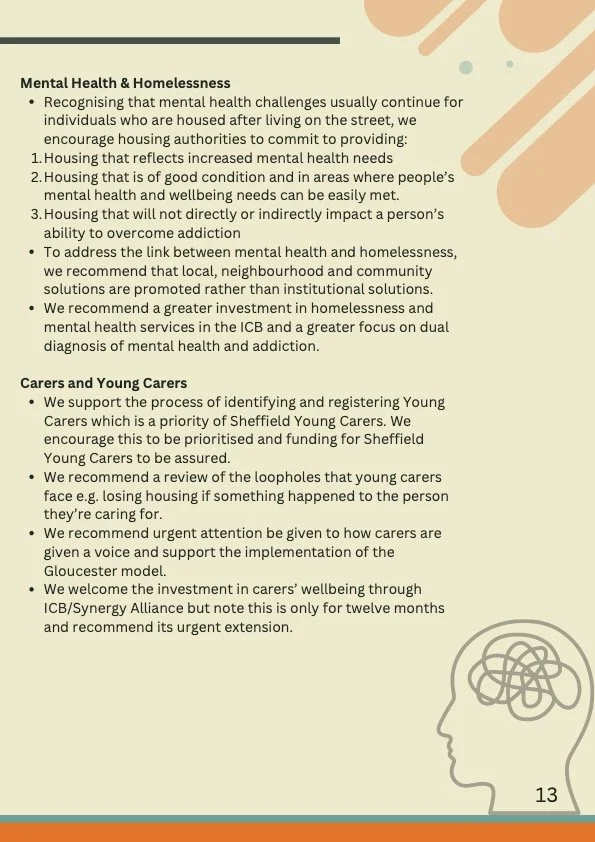

Summary of our Recommendations.
The recommendations emerging from Poverty Truth Commissions are shaped by lived experience and grounded in real relationships between Community and Civic Commissioners. While each Commission reflects its local context, common themes consistently emerge — pointing toward changes that are both practical and deeply human.
Several recommendations appeared across more city-wide priorities for Sheffield:
Embed lived experience in decision-making
Develop more joined-up, relational services
Prioritise community-based, long-term approaches
Invest in compassionate communication and training
Support carers and young carers
At the heart of many recommendations is the need for systems to treat people with dignity and respect. Community Commissioners frequently describe experiences of stigma, judgement, and being made to feel invisible within services. As a result, Commissions often call for a cultural shift across organisations — one that recognises people as individuals with strengths, not just needs.
This includes improving how services listen. Too often, people experiencing poverty feel that their voices are ignored or that they must repeat their stories without being heard. Recommendations therefore emphasise co-production — designing services with people, not for them — and embedding lived experience into decision-making at every level.
Another key area is accessibility. Complex systems, unclear communication, and bureaucratic barriers can make it difficult for people to access the support they need. Commissions often recommend simplifying processes, improving communication, and ensuring that services are easier to navigate, particularly for those facing multiple challenges.
Financial insecurity is also a central concern. Commissioners highlight how low incomes, insecure work, and gaps in support systems create constant pressure and uncertainty. Recommendations frequently call for more responsive and flexible support, including better crisis provision and changes to how financial assistance is delivered.
Housing, health, and wellbeing are also recurring themes. Stable housing is recognised as a foundation for everything else, and Commissions often advocate for improved access to safe, affordable homes. Similarly, there is a strong emphasis on the connection between poverty and mental and physical health, with calls for more holistic, joined-up approaches to support.
Importantly, many recommendations focus not just on services, but on relationships. Commissioners consistently emphasise that positive, trusting relationships with frontline staff can make a significant difference. This leads to recommendations around training, support, and creating the conditions for staff to build meaningful connections with the people they serve.
Accountability and long-term commitment are also key. Commissions often highlight the need for organisations to move beyond short-term initiatives and to embed change in lasting ways. This includes ongoing involvement of people with lived experience, as well as clear mechanisms to track progress.
SUMMARY OF OUR MAIN RECOMMENDATIONS
Our main recommendations focused on three areas:
Early Years, Children and Young People
Systems
Mental Health
You can scroll through them below but also download the report in full.